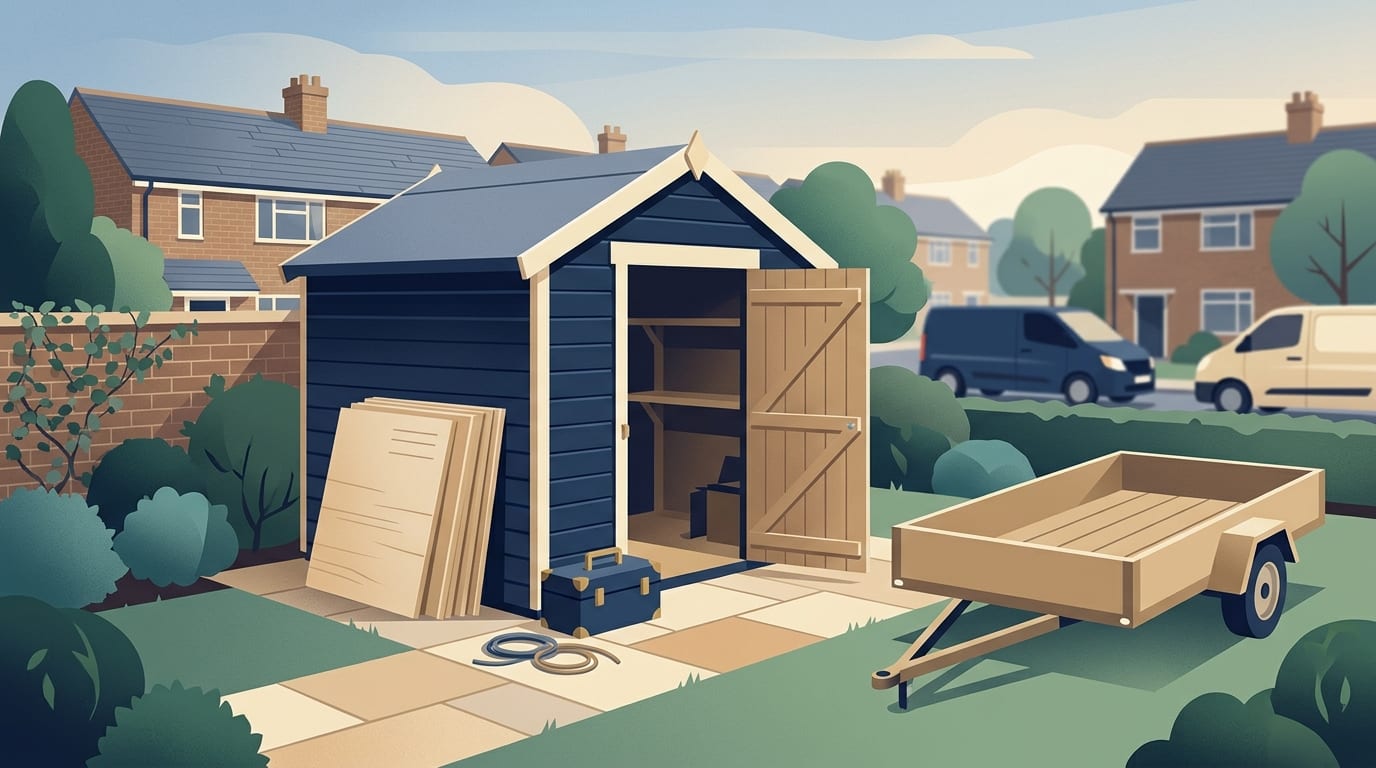
You can usually take a freestanding shed with you when you move house if the sale paperwork says so in writing. However, many removal firms do not dismantle sheds as part of a standard move. The British Association of Removers Code of Practice lists garden sheds among the services a remover may not normally provide. Because of this, you will probably need to hire a shed specialist, a handyperson or the shed maker to do the work. Typical 2026 prices to take a timber shed down run from £150 to £400 before any rebuild costs are added.
Can you take your shed with you when you move?
You can take your shed with you, but be sure to specify in writing that you are taking it. Do this early in the conveyancing process, and do not assume the buyer expects the shed to go.
During the sale, you will complete a TA10 form. This is a standard legal document showing all the fixtures and fittings included in a property sale, and it is usually completed by the seller at the start of conveyancing. If you plan to take your outbuilding with you, you should specify this clearly in writing so the buyer knows what to expect.
All items listed on the TA10 form as included must be left at the property for the buyers. If you state that an item is to be left and then you take it, you could face a legal claim in the future. If you are unsure whether your outbuilding counts as a fitting you can remove, ask your conveyancer for advice before you sign any documents.
Will a removal firm move a shed?
A removal company normally gives a fixed written quote after a pre-move survey, which is a home visit or video call to assess the volume of your goods and the access to your property. Volume means how much there is to move, which sets the vehicle size and the number of crew sent on the day. Some general removal firms do not offer shed moves as part of this service. They may quote higher for the extra labour, or they may lack the right equipment.
The removals trade is not licensed, but many reputable firms belong to the British Association of Removers (BAR). Under clause 3.6 of the BAR Code of Practice, members must draw attention to services a customer might expect but which would not normally be provided. This specific clause lists dismantling and erecting bedroom and kitchen furniture, children's climbing frames, greenhouses, garden sheds, planters and the maintenance of plants.
Clauses 3.7 and 1.3 of the same Code state that members must give fixed price written quotations with a clear description of the work. If a removal firm does agree to transport your outbuilding, ask for all the dismantling work to be written into the quote or contract. The contract must also draw attention to cancellation and postponement charges, limits of liability and the time limit for claims. Standard industry terms commonly limit a remover's liability to a modest sum per item, such as £40, unless a higher value is declared and paid for. Always ask for the liability terms in writing and check what your home contents insurance covers during a move.
Who can dismantle and move a shed?
If your removal firm declines the job, the first recommendation is to hire a professional shed moving company. You could also use a local handyperson or contact the manufacturer to see if they offer a relocation service. A man and van service usually charges by the hour with a minimum booking and suits smaller loads and single items, so ask whether it will take a shed on.
Moving a shed whole without dismantling it is advised against because the structure is more likely to twist. Moving a shed whole can also void its guarantee or warranty. A specialist will dismantle it first.
Wooden sheds can be tricky to disassemble, and a shed embedded in the ground is harder to move. Metal sheds can be taken apart in panels. An average eight by six foot shed typically weighs about 200 to 225 kg. Plan for at least two helpers, and use a specialist for the lifting rather than doing it yourself.
How much does it cost to take a shed down?
The price of moving a garden building is driven by volume, distance, access at both ends, the number of crew needed, and the day and time of year. Month ends, Fridays and summer are the busiest times in the property market, so dates there book up first. You should get about three written quotes based on a survey before you book.
The table below shows typical 2026 prices for taking a shed down and removing it. These vary by area, access and base, and are not a relocation and rebuild price.
|
Shed type |
Typical cost |
Time taken |
|---|---|---|
|
Small timber shed (6x4 ft) empty, dismantle and remove |
£150 to £250 |
1 to 2 hours |
|
Medium timber shed (8x6 ft) empty, dismantle and remove |
£220 to £350 |
2 to 3 hours |
|
Large timber shed (10x8 ft or more) empty, dismantle and remove |
£300 to £400 or more |
3 to 4 hours |
Separately, typical 2026 prices put a standard shed dismantle and removal at £150 to £325, taking 2 to 5 hours. These figures were compiled differently from the table, so do not combine them. Typical 2026 prices put London and the South East higher, by 20 to 30 per cent in some estimates. Estimates vary: some 2026 price lists put a standard dismantle and removal at £150 to £325, others at £150 to £400 for timber. Metal sheds cost £180 to £350 to empty, dismantle and remove, while concrete panel sheds cost £350 to £600 or more.
For moving a shed, some 2026 estimates typically fall between £200 and £600, and oversized sheds or complicated moves can exceed £1,000. Labour is sometimes charged at a set rate of £120 to £300, or £15 to £30 per hour. If you are leaving the old base behind, breaking up a concrete or slab base is usually charged separately. You may also need to pay £15 to £300 for garden waste removal, or between £70 and £400 for skip hire to clear the old site.
A moving specialist will adjust their final price based on a few common factors. They will look at:
- The size and material of the structure, with concrete and large timber costing more to handle.
- The style of the roof, because apex and corner designs take longer to dismantle than overlap or pent models.
- The distance between your old house and your new property.
- Site access at both ends, including long carries from the garden to the road.
- Whether the structure has a reinforced concrete or paved base that needs breaking up and clearing.
How to prepare a shed for moving
Before the professionals arrive, get the structure ready. A specialist will tell you exactly what they need you to do, but these steps are a good start.
Follow these steps to prepare the building for a safe dismantle:
- Empty the shed completely so the moving team has clear access to the floor and walls.
- Remove glass panes and doors only if the specialist advises you to do so.
- Clear a wide path from the shed to the road and check for slippery wet patches.
- Tell the moving company if the shed is cemented to the ground, as it may not move without new floor panels.
- Declare anything heavy, fragile or valuable stored inside so the crew brings the right equipment.
On moving day, watch how the panels are handled by the crew. Note any damage on the day and report it in writing promptly to the company. Standard industry terms often mean damage claims are refused if items were self-packed or if the damage was reported too late, so quick communication is essential.
What to check about the base and the new site
A shed sitting on a concrete base usually means building a new base at the new site. Measure the new spot carefully and check the distance from the fence. You must ensure you can reassemble the panels easily and that all four sides are accessible for future maintenance.
If the van needs to park on a busy street outside your new home, you may need to arrange a parking suspension or permit with the local council. If keys are released late on completion day, your moving crew will be sitting outside waiting for access, which can result in waiting time charges being added to your final bill.
Planning Portal guidance for outbuildings in England sets these allowances. They must not be placed in front of the principal elevation of your house and must be single-storey only. The maximum eaves height is 2.5 metres, with a maximum overall height of 4 metres for a dual-pitched roof or 3 metres for any other roof. If the building is within 2 metres of a boundary, it can be no more than 2.5 metres high. All buildings and additions together must take up no more than half the land around the original house.
You can read the full outbuilding limits on the Planning Portal. These allowances apply to houses, not flats or maisonettes. Designated land such as national parks, conservation areas and World Heritage Sites has extra limits. Any outbuilding within the curtilage of a listed building needs planning permission, so always check your local council rules before you start building a new base.
Asbestos and electrics in an older shed
Sheds built or refurbished before 2000 with asbestos cement roofs are likely to contain asbestos. Asbestos was used widely in UK construction until it was banned in 1999, and buildings constructed after 2000 are unlikely to contain it. When asbestos is in good condition and not disturbed, the risk of exposure is extremely low.
Drilling or demolition can disturb it. Do not break, drill or disturb an asbestos roof, and do not dump it. Leave this work to a licensed specialist. Typical 2026 prices put asbestos shed removal at £300 to £400 and asbestos roof removal at £300 to £400, and asbestos adds extra hours or days to a job. You can read more about the risks on the HSE asbestos safety page.
If your garden building has a power supply, leave the disconnection to a registered electrician before the move. Supplying power to a garden building falls under Part P of the Building Regulations. The electrician doing the work must be properly registered, and you must tell your local council building control team when you add a new electrical circuit to an outbuilding. Under no circumstances should you attempt to disconnect or reconnect live cables yourself.
Selling a house with a shed you want to take
When you are buying and selling in a chain, the completion date is often not fixed until late in the process. This makes booking tradespeople difficult. Under the Consumer Contracts Regulations 2013, the usual 14-day cancellation right does not apply to the transport of goods booked for a specific date. This means the firm's own cancellation and postponement terms are what count, and they must be read carefully before you pay a deposit.
If taking the structure proves too expensive, or if your moving dates change rapidly, you do not have to move it. You can sell, give away or leave the structure for the new owners. If you leave it, make sure this is recorded accurately on the TA10 form so the buyer knows what is included.
A business running goods vehicles over 3,500 kg gross weight must hold a goods vehicle operator's licence, which applies to large removal lorries but not to a standard van. Check the business address, read their reviews over time, and look at their insurance and liability terms. If they claim to be a BAR member, verify this on the BAR website. Members offer an Advanced Payment Guarantee that protects deposits if the member fails before the move, and they give access to a free independent dispute resolution service.
Common questions
How long does dismantling a shed take?
Estimates vary. Some 2026 price lists give 2 to 3 hours for a small wooden shed, 4 to 5 hours for a large wooden shed, 1 day for a brick shed and 1 to 1.5 days for a concrete shed, while others give 1 to 2 hours for a 6x4 ft timber shed and 3 to 4 hours for a 10x8 ft or larger one. Asbestos adds extra hours or days.
Can I move a storage shed without taking it apart?
Moving a shed whole is not recommended because the timber structure is more likely to twist during transit. Moving it without dismantling it can also void the manufacturer guarantee or warranty. A specialist will usually take it apart into flat panels to transport it safely.
Will a removal company dismantle a garden shed?
Not always. The BAR Code lists garden sheds, greenhouses and climbing frames among services a customer might expect but which would not normally be provided, so ask the firm and get the answer in your written quote. A shed specialist, a handyperson or the shed maker may be the better choice.
How much does it cost to move a summerhouse?
Typical 2026 prices put summerhouse removal at £500 to £1,000. That is not a price for relocating and rebuilding it, so ask for a written quote that says what is included.
Next steps before you book
Getting your garden building ready for a house move requires early planning and clear communication. Follow these steps to get organised before you pay a deposit to a tradesperson:
- Complete your TA10 form accurately and state in writing that you are taking the outbuilding with you.
- Check the age of the structure and hire a licensed specialist if it was built before 2000 and might contain asbestos.
- Ask your removal company if they can transport the dismantled panels in their lorry or if you need a separate van.
- Get a fixed price written quote from a moving specialist that clearly includes dismantling and reassembly.
- Measure the new garden to ensure the structure fits within local planning rules and has clear access on all four sides.
- Book a registered electrician to disconnect the power supply and install the new circuit safely at the new property.
Moving a large outbuilding safely takes time and the right equipment, so it is wise to arrange this early in your moving journey. Once you know who is handling your garden building, you can focus on the rest of your household belongings and find a mover near you to transport your boxes on completion day.
Find a top rated mover near you
2,925 movers across the UK, each ranked on their Google rating and the number of reviews behind it. Start with your county: