To know how to pack glasses for moving, you must wrap each fragile item separately in packing paper or bubble wrap and pack it into a sturdy box with no gaps. Label the carton clearly as fragile and keep your boxes of books small so they stay light enough to carry. A methodical approach to your kitchen and living room prevents breakages and ensures your removal firm can load your belongings safely.
What you need to pack fragile items
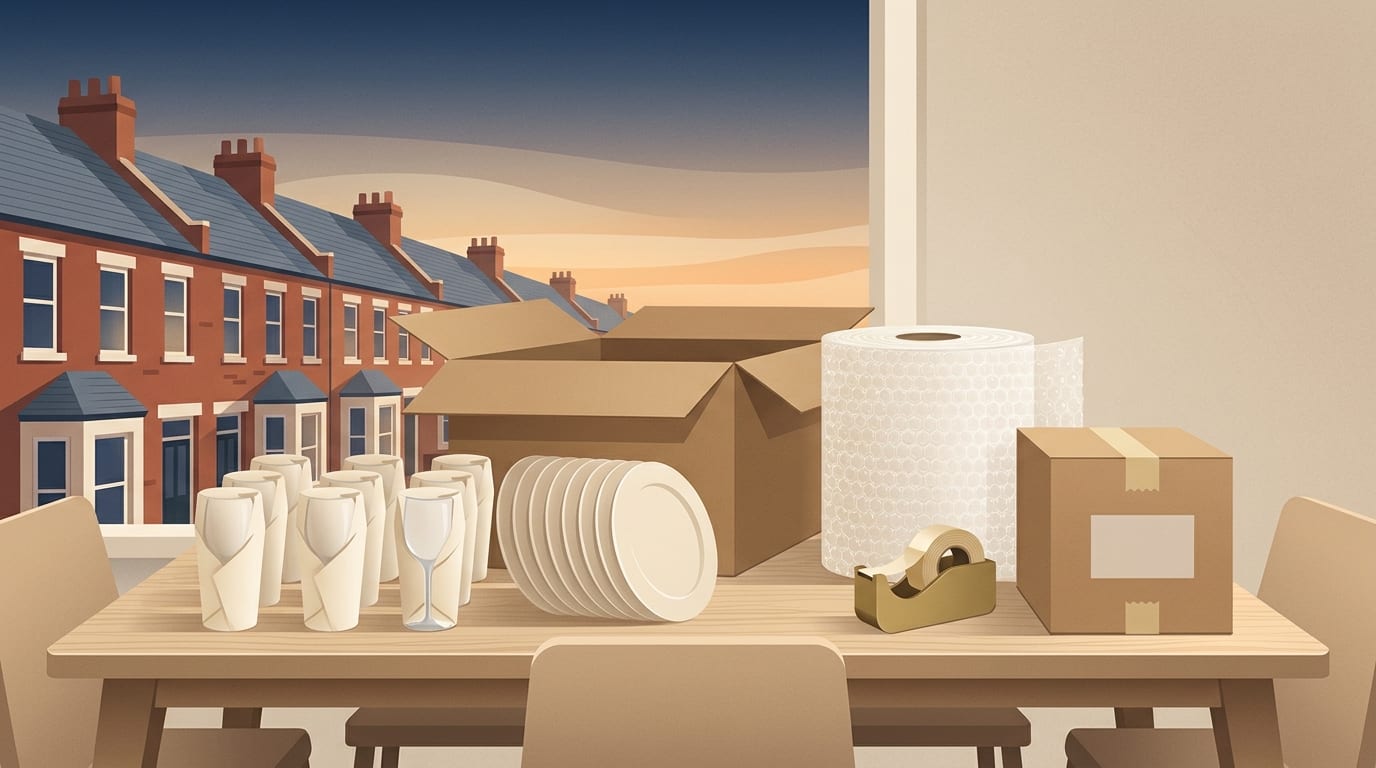
Start by gathering the right materials to protect your breakables. Different items need to be wrapped and packed differently and sometimes with specialist materials. Use sturdy boxes for kitchenware, and keep them small enough to carry safely.
You will need plenty of packing paper to wrap individual items and fill gaps. Bubble wrap suits highly delicate pieces. Secure your boxes with strong tape so they cannot open in transit.
You can buy these materials from packaging suppliers or hardware shops. Alternatively, you can ask your removal company for boxes and materials, which they often provide at a reasonable cost. Knowing how many moving boxes to buy depends on the size of your kitchen, but it is always safer to order more packing paper than you expect to use.
- Small sturdy boxes for kitchenware.
- Large packs of plain, unprinted packing paper.
- Rolls of bubble wrap for mirrors, televisions and ornaments.
- Strong packing tape and a handheld tape dispenser.
- Thick marker pens for labelling every carton clearly.
- Small plastic bags for screws, bolts and brackets.
How to pack glasses for moving
Prepare a small, sturdy box by taping the bottom seam firmly. Scrunch packing paper into loose balls and line the bottom of the box. This creates a shock-absorbing base for your glasses.
Place a stack of flat packing paper on your table. Take your first glass and lay it on its side at the corner of the top sheet. Roll the glass forward, folding the sides of the paper into the bowl of the glass as you go. Fill the inside of the glass with paper as well.
For thin wine glasses or crystal, roll the item in a second sheet of paper or a layer of bubble wrap. Stand the wrapped glass upright inside the box on top of your crumpled paper base. Stand glasses upright in the box rather than laying them on their sides.
Continue wrapping and placing your glasses upright in a single layer. Once the bottom layer is full, push scrunched paper into any gaps between the glasses so they cannot move or rattle. If there is room for a second layer, place a thick pad of crumpled paper over the first tier before starting the next.
Leave a gap at the top of the carton and fill it entirely with scrunched paper. Fold the flaps down and seal the box securely with tape. Before labelling, gently shake the box to check for movement, and add more paper padding if you hear glasses shifting.
How to pack plates and crockery
Plates require a different technique to glasses because of their shape and weight. Tape the bottom of a small, strong box and line it with a thick layer of crumpled packing paper. Everyday dinner plates are heavy, so a small box prevents the load from becoming too difficult for you or the removal crew to carry.
Place a plate in the centre of your flat packing paper. Fold one corner of the paper over the plate, covering it completely. Place a second plate on top of the first, and fold the opposite corner of the paper over the new plate. Repeat this to make a small bundle, then wrap the entire bundle tightly in another sheet of paper.
Place the wrapped bundle of plates into the box on their edges. Stand plates on their edge in the box rather than stacking them flat, because flat plates are more likely to break under the weight of what is packed on top.
Wrap bowls individually by placing them on the paper and tucking the edges inside the bowl. You can then nest a few wrapped bowls together and wrap the nested stack in a final sheet of paper. Stand these on their edges next to your plates, pushing them tightly together.
Fill every gap around the sides and between the bundles with crumpled paper. Crockery breaks when it moves inside the carton, so a tightly packed box is much safer than a loosely packed one. Top the box with more scrunched paper, seal it with tape, and test it for rattling before you set it aside.
How to pack books without overloading boxes
Books are heavy and quickly make a box that is hard to lift. You must use small boxes only for your library, and never pack one large box entirely with books. A removal crew will struggle to carry an oversized, overloaded box, and the cardboard bottom is likely to tear open under the strain.
Line the bottom of the box with paper and pack your books neatly in layers so they cannot shift.
Sort your books by size before you begin. Packing volumes of a similar size together helps you build level layers inside the box. If you have delicate antique books, wrap each one individually in plain packing paper to protect the covers from rubbing against each other.
Fill any empty spaces at the sides or top of the box with crumpled paper. If a book box is only half full but already heavy, do not add more books. Instead, fill the remaining space with light items such as cushions, towels or scrunched paper to prevent the carton from crushing when another box is stacked on top.
How to pack mirrors and framed pictures
Mirrors and picture frames require rigid protection to stop the glass from flexing and shattering. Lay the mirror face up on a clean, flat surface. Cover the glass entirely with packing paper, securing it to the edges with a low-tack tape that will not leave a sticky residue on the frame.
Wrap the entire mirror or picture in bubble wrap, paying close attention to the corners, which are often the most vulnerable points. You can buy cardboard corner protectors to fit over the edges before you apply the bubble wrap.
Slide the wrapped mirror into a flat, telescoping picture carton. These cartons come in two sliding halves that adjust to the size of your frame. Push the two halves together tightly and tape them securely so the mirror cannot slide around inside the cardboard shell.
Store your packed mirrors and pictures on their edges, leaning against a wall in a low-traffic area until moving day. Do not lay mirrors flat, as pressure on the centre can crack the glass. For valuable art, read our guide to moving antiques and artwork.
How to pack a TV for moving
Modern flat screen televisions are delicate and easily damaged by pressure or twisting. The safest way to move a television is in its original box, complete with the polystyrene inserts that hold the screen away from the cardboard. If you kept the original packaging, slide the television back into its foam supports and tape the box shut.
If you do not have the original box, you will need a heavy-duty television carton and plenty of padding. Unplug the television and photograph the cables at the back before you disconnect them. Remove the stand, wrap it in bubble wrap, and pack it in a separate box so it cannot scratch the screen.
Wrap the television in a soft blanket or a thick layer of bubble wrap, securing it gently with tape. Do not pull the tape so tight that it places pressure on the screen. Slide the wrapped television into the flat screen carton and fill the empty spaces with bubble wrap or soft linens to hold the unit firmly in place.
Keep the television upright at all times during packing and loading. Never lay a flat screen television on its screen. Label the carton clearly on both sides to ensure the removal crew carries and loads it in the upright position.
Labelling fragile boxes
A clear labelling system tells your removal crew how to handle the box and where to place it in your new home. Use a thick, dark marker pen to write directly on the sealing tape or on a bright sticker. Write on the sides of the box rather than the top, so the label remains visible when several cartons are stacked in the van.
The British Association of Removers advises you to label each box clearly with its contents and destination room. Keep fragile items well protected with bubble wrap or packing paper inside the box, and mark the outside with the word fragile in large letters. This tells the crew to take care with it.
When dismantling furniture to pack alongside your boxes, place the screws and bolts in small bags and tape them to the corresponding furniture. This ensures the hardware travels with the frame and is immediately available when you begin reassembly in your new home.
- The destination room in the new property.
- A brief summary of the contents inside the box.
- A clear fragile warning on at least two sides of the carton.
- An upward-pointing arrow to show which way the box must be carried.
Packing yourself or paying a professional packer
Packing your own boxes can lower the cost of the move, but removal firms often treat items the customer packed themselves differently from items packed by their own crew. Standard industry terms commonly limit a remover's liability to a modest sum per item, for example £40 per item, unless a higher value is declared and paid for.
If a glass or plate breaks inside a box you packed, the firm may treat the claim differently from damage to items its own crew packed. You must ask your mover for their liability terms in writing before you begin packing. You should also check what your home contents insurance covers during a house move, so you know where you stand.
The BAR states that packing can be one of the most time-consuming parts of any move. BAR members use trained staff and high-quality materials to protect your belongings. If you decide to handle the general packing but want the kitchen handled by experts, fragile packing can be agreed beforehand with the mover.
If you start packing and realise you cannot finish in time, notify your mover in advance. Extra packing help may cost more if you ask late. Knowing the professional packing costs early helps you make an informed choice during your pre-move survey.
Regardless of who packs the boxes, you must take responsibility for highly valuable items such as jewellery yourself. The BAR reminds customers that no mover can guarantee that belongings will not get damaged in transit, so keep your most precious personal items with you in the car on moving day.
Common questions
Do I need special boxes for glasses?
Small sturdy boxes are fine as long as you wrap each glass individually, pad the base and top of the box with scrunched paper, and stand the glasses upright.
Should I use newspaper to pack crockery?
Plain, unprinted packing paper is the usual choice for wrapping plates and glasses, and your removal company may be able to supply it. Printed paper such as old newspaper can leave ink on what you wrap, so many people avoid it.
How do you stop plates rattling in a box?
Plates rattle when there is empty space inside the carton. To stop this, you must push scrunched packing paper firmly into every gap around the sides and between the wrapped bundles. A tightly packed box prevents the plates from shifting and striking each other during transit.
Can you pack a TV without the original box?
Yes, you can pack a television without its original packaging by using a heavy-duty flat screen carton. You must protect the screen with a soft blanket or bubble wrap, secure the television upright inside the carton, and fill the remaining space with soft padding so the unit cannot move.
Next steps before moving day
Packing your kitchen and living room takes longer than most people expect. Start early, order your materials in bulk, and clear a dedicated space to wrap your fragile items safely.
- Ask your removal company for a quote that includes strong boxes, paper and tape.
- Check your home contents insurance for transit cover on self-packed boxes.
- Ask the mover for their written liability terms and check the limit per item.
- Pack books into small boxes only and keep them light enough to lift safely.
- Label every box with its destination room and mark delicate items as fragile.
- Tape screws and bolts in small plastic bags directly to the dismantled furniture.
Once your packing plan is in place and your completion date is reasonably firm, it is time to secure your removal team. To get started, find a mover near you to arrange a pre-move survey and discuss your packing needs.
Find a top rated mover near you
2,924 movers across the UK, each ranked on their Google rating and the number of reviews behind it. Start with your county: